Great apes can mirror each other’s facial expressions and grimaces as part of a complex communication process. A new study sheds light on how this actually works.
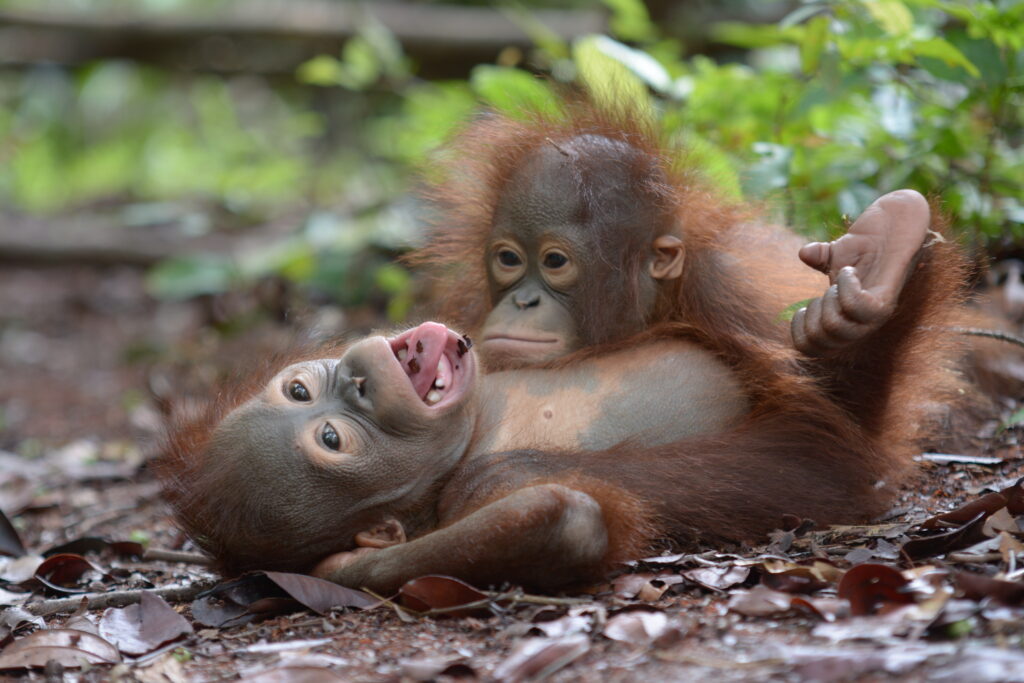
Orangutans and other great apes can do something very special. They replicate each other’s facial expressions, just like us humans do.
Although this is common knowledge, a new study has shown that orangutans and chimpanzees, the two ape species studied, mirror each other much more accurately than previously thought.
“What we found was remarkable – these animals don’t just replicate a general expression, they copy the exact same facial movement pattern their social partner uses,” said study author Diane Austry of the University of Portsmouth to phys.org.
The research was conducted at the University of Portsmouth and published in the academic journal Scientific Reports.
Read also: The unique ability of orangutans to mirror facial expressions
Good playmates are replicated more accurately
The researchers studied the facial expressions of 96 orangutans and chimpanzees in social situations and examined whether they mirrored each other’s smiles and laughs within three seconds. They also compared whether the apes’ teeth were visible or not when they smiled.
In addition to revealing a very accurate replication, which may indicate a complex act of communication, it appeared that the apes were most likely to remember a facial expression when the teeth in the upper jaw were not shown. This confirms what we already know about the primate world – that shown teeth can indicate aggression.
The new study also observed how long and how intensely the apes played together and if this affected whether they mirrored their playmate’s facial expressions. It was found that orangutans who had played together for a longer period of time were also more accurate in replicating their friend’s facial expressions.
Read also: Great apes remember old friends
Confirms our similarities
Save the Orangutan’s primatologist, Daniel Krejmar Nielsen, finds the new study exciting, although he notes that the study was conducted on orangutans at a rehabilitation centre, not in the wild:
“It’s a cool study. It was conducted on captive apes and you can’t say for sure that the results can be replicated with wild orangutans. But there’s no doubt that there are many behavioural similarities between us humans and great apes,” he says.
These skills and similarities to humans are taken into account in the work at the rehabilitation centres, and they help to emphasise the importance of the orangutan as a species.
“The study further shows how similar humans, orangutans and other great apes are. Orangutans have needs and feelings just like humans. They are among our closest relatives and they should not suffer in silence. That is why we aim to care for them, just as we humans are there for each other when we need help,” says Daniel Krejmar Nielsen.